

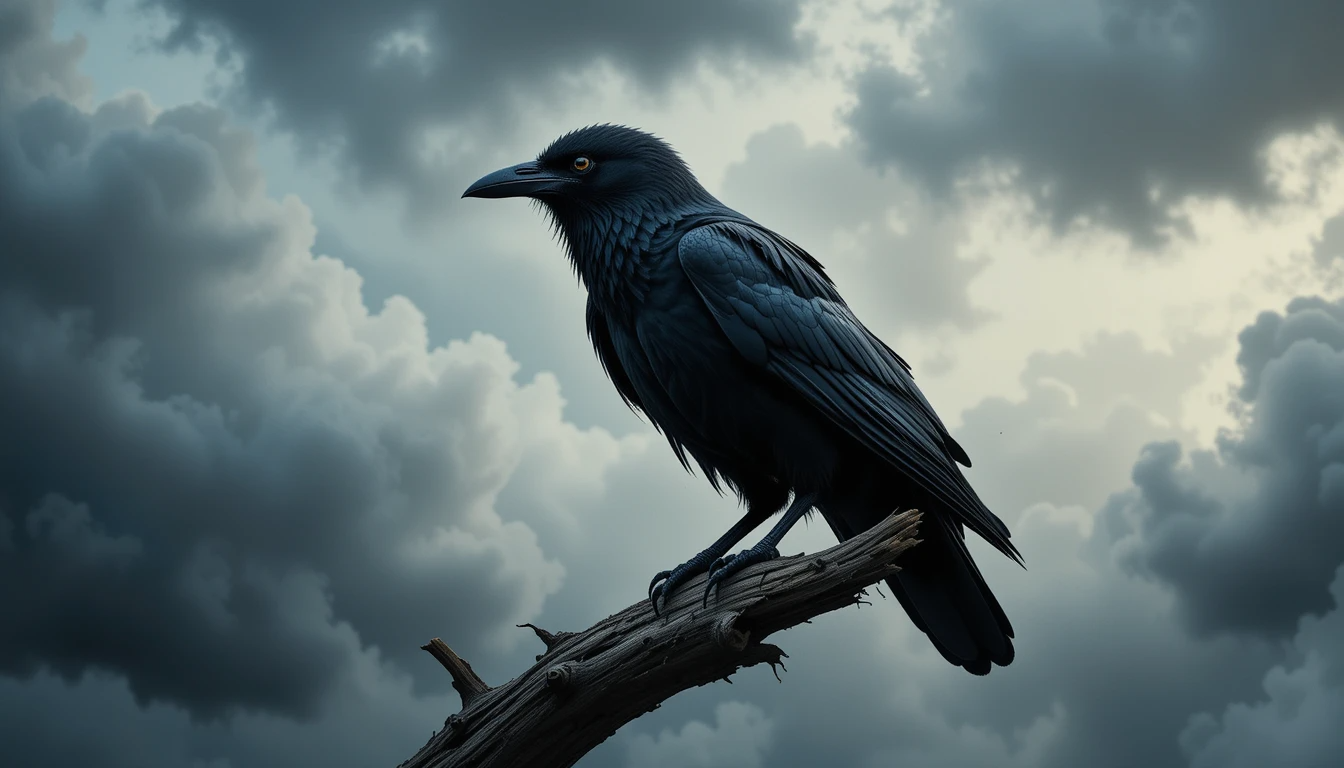
The crow has long been a creature shrouded in mystery, inspiring both fear and admiration. Its image in various cultures ranges from an omen of bad luck to a symbol of wisdom, but what everyone agrees on is its extraordinary crow intelligence, making it one of the smartest creatures on Earth.
A Historical Reputation: Omen of Doom and Guardian of the Crown
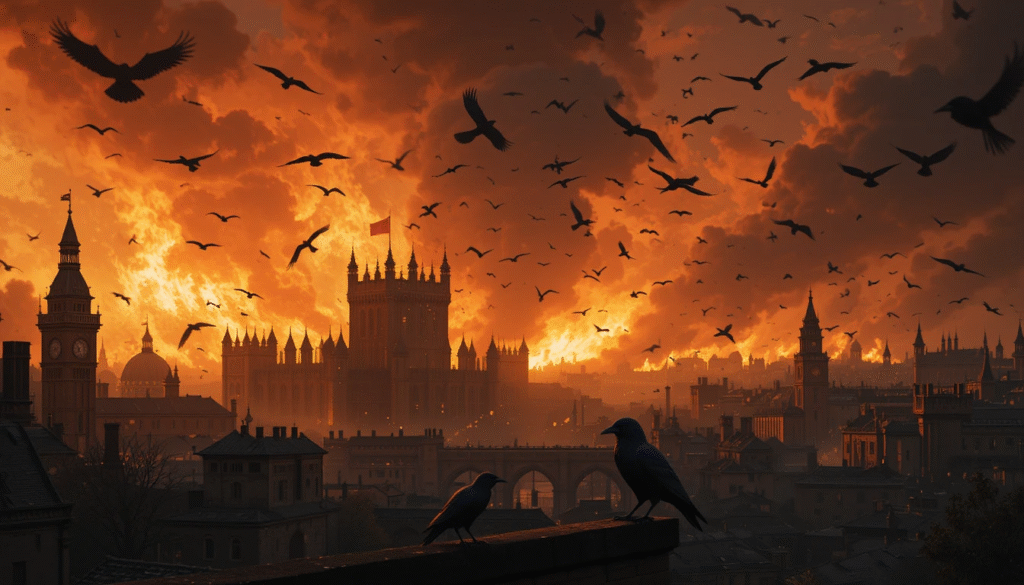
In the dawn of September 2, 1666, the Great Fire of London destroyed over 13,000 homes. As the people of London wept for their loved ones, flocks of ravens appeared in the city’s sky, devouring the unburied corpses. This horrific scene reinforced the prevalent belief since the Victorian era that the ravens of London protect the crown and that their removal could bring ruin. This was not the first time ravens had done this; two years prior, the plague spread and left thousands dead whose bodies were consumed by ravens. Although the king was then forced to kill most of the ravens, he kept six in the Tower of London to protect the throne.
These historical events show how the crow became associated in Western folklore and literature with ill omen, death, and destruction, even being called “the devil’s companion.” When we see other birds, we see them as just birds, but the crow conjures up mystical symbolic images related to death in our minds, simply because a fundamental part of its diet is carrion and corpses. Therefore, when wars break out, ravens rejoice and follow armies, waiting for those who will fall in battle.
While this idea is terrifying and makes many cultures superstitious about the crow, other cultures found solace in it, especially those who view life as a continuous cycle of birth and death. For them, ravens and other scavengers are essential for environmental cleanup and the recycling of elements back into nature. For example, Zoroastrians would leave their dead exposed for vultures and ravens to eat, and some other cultures would dismember bodies to make it easier for these birds.
The Planet of the Crows: A Global Journey from Australia
In her book “The Planet of the Ravens,” scientist Jananda Haupt states that many animals feed on carrion, such as hyenas, crocodiles, pigs, and vultures, but what distinguishes the crow is its brazenness in performing this horrific act in the heart of the city! And crows, dear reader, are found in every corner of the world, on almost all continents, with the notable exceptions of Antarctica and South America. The question here is, why didn’t crows go to South America, even though it’s the continent of birds?
To answer this question, we must return to the story of the crow on Earth from the beginning. Crows are a family that includes 139 species, the most famous of which is the black crow that inhabits the northern hemisphere. There are other species such as the carrion crow, the hooded crow, and the fan-tailed raven, which is characterized by its brown neck and lives in the Arabian Peninsula, Sinai, and southern Iran.
The crow known in Egypt is the hooded crow, or magpie, which is a resident crow that does not migrate, and is classified as a “Crow” not a “Raven.” The difference between them lies in size, voice, and behavior; the “Raven” is larger, has a deeper voice, and is usually seen alone, while the “Crow” is smaller, noisier, and flies in groups. It is likely that all crows descended from ancestors that lived in Australia before spreading around the world.
Regarding their absence in South America, the reasons are mostly geographical, as mountains and deserts once prevented them. And although the Isthmus of Panama emerged, providing a path for animals, it was too late for crows; other birds like jays and gulls had already taken their place in the environment.

The Crow’s Social Fabric: Loyalty and Cooperative Survival
But let’s not unfairly judge the crow, for its bad reputation overshadows its extraordinary capabilities and powers. The crow is a loyal, monogamous bird that forms a lifelong pair bond with one partner. The pair builds a nest together, and the female incubates the eggs for 18 days while the male takes on the role of protecting and feeding them. After hatching, the male cleans the nest. After a month to 40 days, the young begin to grow full feathers and their wings become stronger, allowing them to fly. They reach mating age between two and four years, but they do not leave the nest.
One of the behaviors that contributed to the success of crows is cooperative breeding, where an individual gives up breeding to help others protect their young. This mysterious behavior in the animal kingdom, where young crows help their family before becoming independent, perhaps because they realize that protecting their sibling, who carries a large percentage of their genes, may be easier than reproducing themselves. Crows typically live for 13 to 14 years in the wild, and up to 20 years in a safe environment.
The Urban Winner: How Crows Conquered the Concrete Jungle
This organized life cycle has helped crows to be very successful in cities. While we talk a lot about animals whose populations have declined due to humans, we don’t talk enough about animals that have thrived because of us.
Scientific literature has introduced two important terms: “Urban Losers” and “Urban Winners.” And the crow, undoubtedly, was a “Winner” like dogs and cats. For example, studies show a negative correlation between the body mass of raptors and their ability to tolerate urban life, while the crow’s size is ideal; it’s not as large as vultures, which are vulnerable, nor as slow-breeding as owls, which need more stability and wider hunting grounds. The crow is an omnivore, eating anything, and survival in cities requires you to be a “Generalist” and eat from garbage.
According to a Somali legend, birds gathered to divide food, and the crow stood up and said: “Any bird larger than me will eat meat, and any bird smaller than me will eat seeds and plants.” And they all agreed, forgetting that they had allowed him to eat whatever he wanted, seeds, plants, and meat. In fact, no creature threatens the crow except falcons and owls, which have already disappeared from cities. By the way, one of the most dangerous things for birds are windows; in North America alone, windows kill a billion birds annually. But this doesn’t affect crows; they are excellent flyers, performing amazing acrobatic maneuvers, and can skillfully adjust their speed and wings.
What also distinguishes the crow is that it is both reserved and bold. When it sees a new animal, it fears it because it could be a threat. The crow is afraid, yes, but it does not flee; instead, it stands and assesses the situation so as not to miss an opportunity. For example, if you try to throw food to a crow in Sinai, it won’t pounce on it like pigeons, but will take its time to trust you, yet it won’t cancel the option entirely like an owl. This balance is the secret of its success.
Unlocking Crow Intelligence: A Mind That Rivals Primates
When we talk about the intelligence of crows, there’s no end to it. According to anthropologist Philippe Descola, when Western science categorized intelligence, it was biased towards mental abilities similar to humans. For years, Western studies ignored what crows do, considering it not intelligence. But we find that almost no culture in the world has failed to pause at the crow and wonder about its actions, from Japan to the Americas, from cave paintings to Van Gogh, the crow has always been endowed with abilities beyond being an ordinary bird.
Consider Arabic proverbs: “More discerning than a crow,” “More vain than a crow” (for its gait), “Purer in life than a crow,” “More ominous than a crow.” And even when Islam forbade pessimism, the crow appeared in the Quran as an animal that teaches humans to bury the dead; it is a creature that teaches humans, and in the Quran, it teaches the father of humanity.
This mythical status of the crow declined somewhat throughout history, but it returned, crowning this creature with intelligence, this time a wicked intelligence. For example, a legend says that when the Prophet Muhammad hid in the cave, a white crow saw him and cried: “Cave! Cave!” to reveal his location. It is said that the white crow was then cursed and turned black, condemned to say: “Cave! Cave!” for the rest of its life.
In other cultures, the crow is seen as an ally or messenger, like the Norse mythology that says Odin has two ravens, Hugin and Munin, who tell him all the news of the world. There are also some cultures that revered the crow, such as the Haida people, who saw the crow as the creator of the earth and seas, and that it stole the sun, moon, and stars and placed them in the sky, and that it brought fire to humans.
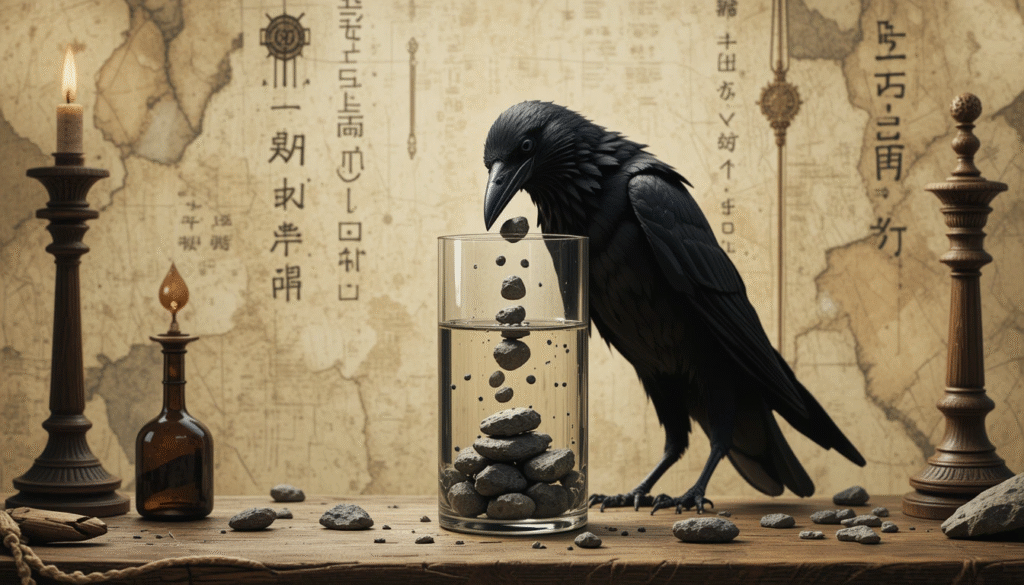
Popular thought was not as reserved as science; it recorded the clever movements and tricks performed by the crow. And when science began to study the crow, it found that the stories were not exaggerated, for the creature is indeed intelligent. The difficulty in studying animal intelligence lies in designing tests that the animal can interact with. For example, a chimpanzee test cannot be performed by a crow simply because a crow does not have hands. Therefore, scientists returned to Aesop’s fable, where a crow, wanting to drink from a narrow vessel, threw stones to raise the water level.
In a 2014 study, scientists found that this story was not a myth. Indeed, they placed two containers in front of crows, one with water and a reward, and the other with sand, and found that the crows ignored the container with sand. And when they changed the experiment and offered them a water tube with other objects of different densities, the crows used the objects that sank, not the objects that float. Why? To be able to raise the water.
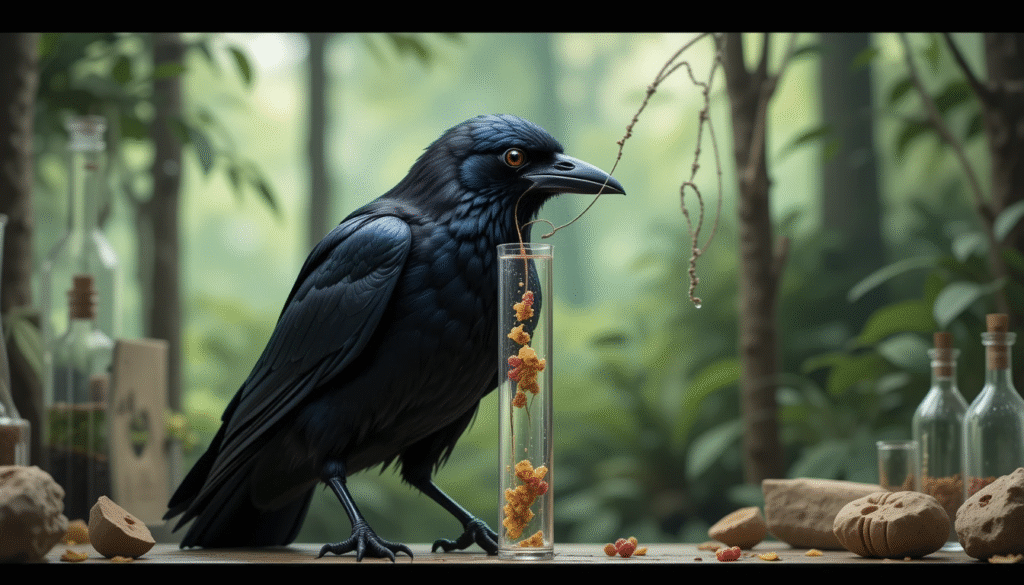
These are skills that a human child acquires between the ages of 5 to 7. The experiment also shows their use of tools. Here, this bird turns an inanimate object into something useful. In 2002, in a laboratory at Oxford University, scientists wanted to test crows’ use of tools. They placed a reward in a narrow tube with a straight wire, and found that the crow bent the wire to make what? A hook. It fishes. The crow is a fisherman, it fishes! It makes tools to help it hunt.
Again, dear reader, this is a bird with a pea-sized brain, and this is not a moment of individual genius; no, this is a documented behavior in crows. They make tools. In the region of New Caledonia, crows make these hooks to pull insects from trees. Also, dear reader, when crows move, they carry their tools with them. They take their gear when traveling or going to work. Researchers have documented this behavior and saw it as similar to what early humans did. You, by the grace of the Prophet, the Stone Age was the Stone Age for what reason? Because you started making tools from stone.
Crows also have a culture of cumulative tool-making, meaning they pass information from generation to generation and build upon it. This tells us about a very important skill in crows, which is planning. Crows are capable of planning and testing solutions in their minds before implementing them practically. And this, dear reader, is a very advanced skill, requiring the animal to recall its memory, anticipate the future, and do something very important: it needs to delay gratification while planning. That “I will exert effort now, and I will get my reward later, when I do the work of now.”
This is a skill that even comes to human children after a while; this idea of investment is not an intuitive idea. In a BBC documentary called Inside Animal Mind, a crow was subjected to one of the most complex tests, a test consisting of 8 stages. It had been exposed to each stage separately before, but this was the first time it faced all these stages together. It was required to plan to know where to start and how to move.
Initially, it gets an idea, grabs the stick, but finds it too short to reach the food. But it thinks that with this stick, it can reach 3 stones located in 3 boxes. It pulls out the first stone, then the second stone, and thinks, not knowing what to do with them! Then it appears, as if it has realized something. You find, dear reader, it throws the stone into a box, which lands on a platform that needs the weight on it to exceed a certain limit. So it brings the second and third stones, and it goes down, so it gets a long stick, and with this long stick, it can get the food.
See? If I were in its place, I wouldn’t have been able to do this! I would have died of hunger by now! If you reflect, you will find here a puzzle of 8 stages, solved by a crow for the first time. But even if this was the first crow to do it, it only needs another crow to see it and it will keep teaching it to others and others, you will find social media! Crows are known that when they learn new strategies, they teach them to their young.
In Japan, for example, crows developed a new behavior. They started, for example, eating a food they couldn’t eat before, like walnuts. You started seeing them do what? They fly over roads, throw the walnuts between cars, and wait for either the cars or the asphalt to crush the walnuts. This is challenge number one. There is still another challenge, “I need to go down and get the food that I wanted to break, without the cars running me over.”
See now, dear reader, what they will do. They will say: “It is clear that humans have made something to organize their cars with, what is this thing called? It’s called the traffic light.” Crows, dear reader, will learn when to eat by the color of the traffic light. They said: “It is clear when the light is green, the cars move, it is clear when the light is red, the cars stop.” Amazing! This behavior we noticed started in the nineties, in one city, which is Sendai. This likely happened because they noticed that walnuts were automatically breaking under cars.
A study published in 2019 documented that this phenomenon is still continuing, and it is spreading to other places, cities, and different villages, with modifications, and parents are teaching it to their children. This, dear reader, over time makes each group of crows have a different culture, a culture that includes, for example, knowing what dangers are around them, like, who are the good people? Who are the bad people? At the University of Washington, a group of students were doing a study, they would catch crows living in the university’s trees, do research on them, weigh them, take measurements, leave marks on them, and then release them again.
The students found, dear reader, that every time they passed in front of the trees, the crows would scream and be very aggressive towards them. This continued for the rest of the year, until they finished university, and even after they left university and returned, the crows still remembered them. So biologist John Marzluff decided to test this hypothesis.
Do crows really distinguish human faces? And can they make judgments about them that last for years? The man did a clever study. He had a group of students wear a rubber mask, similar to the masks worn by cavemen, and another group wore a mask of an ordinary person.
And he sent the people who wore the cavemen masks, and the cavemen went and caught the crows and repeated the same measurement process I told you about, which it seems the crows did not like. And the other group who had ordinary masks did nothing. The study, dear reader, found something very strange. The crows kept remembering these faces for almost 7 years, and even the crows that were not present at the incident participated in the aggression, as if the news of the danger had spread among the flock.
On the other hand, crows also remember people who offer them food, who are kind to them. But let me ask you a question. What if the genius of crows is not just actions, but also speech? Let me tell you that crows can actually learn to pronounce words, up to 100 different words they hear around them. There are recorded cases of crows hearing the sound of humans calling their dogs or other animals, so you would find them, dear reader, imitating the sound to tease the animal and have fun.
What distinguishes the crow from other songbirds, although their vocal cords are almost similar, is that most birds take a short time at the beginning of their lives to learn the sound they will make, and then they stick to it. Crows, on the other hand, throughout their lives, dear reader, learn new sounds. Why? Because they have independent muscular control over the sides of their vocal cords, which allows them to make different sounds throughout their lives.
The crow’s voice, dear reader, is not just a cry, not a shout, it is a complex system of sounds, each sound has a function. There is a warning sound, a defense sound, a welcoming sound, “Welcome, we have dead with us.” There is also a sound for learning, a sound for scolding the young ones. Crows have a basic feature of language, and this feature is recursion, the embedding of one structure within another.
For example, in language, we put a sentence inside a sentence. The recursion here is to say “The boy who painted the picture won the prize.” Humanitarians like Noam Chomsky considered this recursion a cornerstone in the construction of human sentences, and thus a unique human trait. But in an experiment, a screen was placed in front of each crow, displaying pairs of nested parentheses, as you see in front of you, a closed bracket inside a bracket of another shape, and they trained the crows on this concept. Open a large bracket, put a small bracket, close the small one, and then close the large one, and then you get a reward.
Congratulations, good job, you are excellent! And then, they started replacing the brackets with different shapes, and instead of two pairs of brackets, they made them 3. They found that the crows got the correct order 40% of the time, and this, dear reader, is the same percentage as children in KG1, and it’s better than monkeys, who needed an extra training session. This test, dear reader, is very important because it is not just a game of symbols, but no, it is a way we can measure the ability of the creature’s mind to build nested structures and follow an abstract rule, an Abstract Concept.
Intelligence Beyond Necessity: Play, Theft, and Friendship
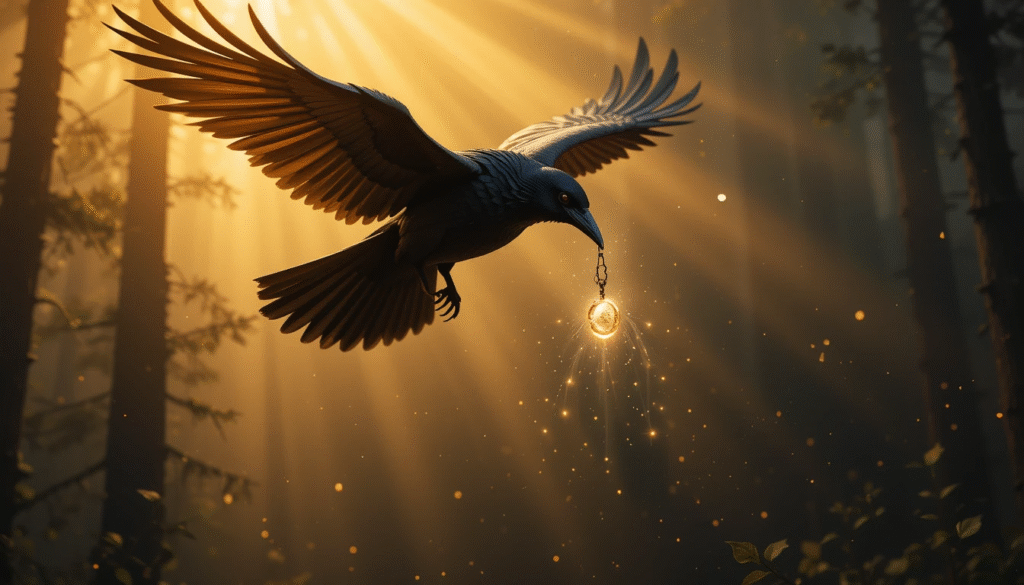
David Quammen, a writer specializing in nature, says that the intelligence of crows is much greater than the intelligence they need to live and coexist. Meaning, you, Mr. Crow, can survive in your life with much less intelligence. The world has likened them to intelligent children who get bored quickly if their environment does not challenge their intelligence, which is why, dear reader, you find them thriving in cities.
In a study co-authored by Dr. Dakota McCoy, she said that she found that crows are very pleased after using tools, just as we enjoy solving crosswords. Crows really enjoy solving a problem, not just for the reward, no, but because they enjoy the process itself. McCoy says that crows’ cognition allows them to perform unnecessary behaviors, like playing or stealing, like a famous thing, although not scientifically documented, crows, dear reader, steal jewelry—thieves! There are also scenes where you find them entering the mall, stealing a bag of “chips,” opening it, and eating it.
These unnecessary behaviors are intended to keep their minds active and their lives exciting. In one of the strangest relationships between animals, this relationship began with crows chasing wolves to eat the leftovers of the animals they hunt.
Also, crows attract the attention of wolves if they find, for example, a corpse, so you find the wolves come to cut the meat and open the intestines for the crows, “Here, you helped me, so join me!” These crows have formed a very strange relationship with wolves, they pounce on them, and the wolves chase them, and sometimes, you find the crows are the ones chasing the wolves, and you sometimes find an “operetta,” a howl of wolves with the screams of crows, there is a feature!
Scientists believe that there are cases of friendship between individuals of crows and specific wolves. All of this, dear reader, must provoke a very important question in you: Why? Why all this? Why does the crow need all this intelligence despite being a bird? According to the research paper, Intelligence in Corvids and Apes, crows needed intelligence to remember the place and time of food, like primates with fruit seasons, and the wide-ranging diet of crows required complex methods to extract it.
The Evolutionary Roots of a Remarkable Brain
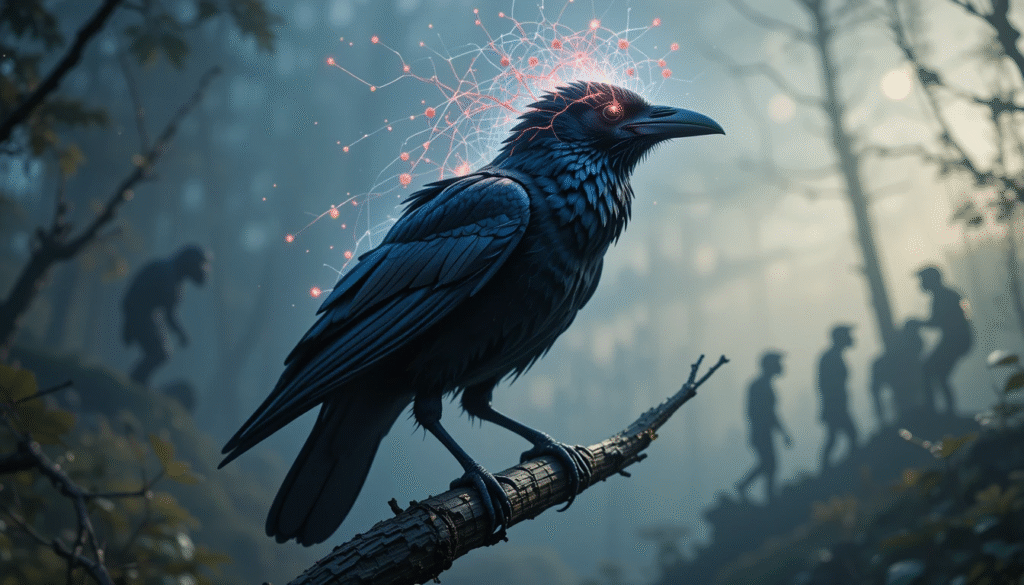
Also, among themselves, there is social competition, like them hiding food from each other, or storing it, whether under leaves or in tree hollows, and if someone sees them while they are hiding it, whether a crow for example or a squirrel, they change the location. This requires memory, planning, and understanding of the other’s perspective, A Theory of Mind. Another theory says that the matter is also related to their upbringing.
Crows spend a long time with their parents, sometimes, dear reader, reaching up to two years. This, in the lifespan of animals, is not a small number. They learn during this time to practice and train before they become independent. All of this, you could say, was formed in the environment of their brain.
Primates, for example, have a structure in the brain called the New Cortex, the neocortex. This is full of nerve fibers extending horizontally and vertically, and this is where advanced perception, learning, and memory occur. But birds do not have this structure at all. Despite that, in a 2020 study, scientists found these fibers and circuits in the brains of birds, organized in a very similar way to this cortex.
What makes it difficult for you to imagine an intelligent bird is that its brain is small, but the idea, dear reader, is not in the absolute size, not in the Absolute Value, but in the ratio of the brain to the body. Crows have a large brain compared to their body size. Let me tell you that in mammals, the largest brain-to-body ratio is in humans. Our brain is the largest brain compared to the body size. But elephants, for example, have a larger brain than us, but compared to their body size, no, we are larger.
When you come, dear reader, to look at birds, you find the largest ratio in crows. Not only that, what determines the intelligence of an animal is the density of nerve cells. In a 2016 study, they measured the number of nerve cells in birds and primates, and found that crows have double the number of cells found in primates of the same brain size. Biologist Bernd Heinrich recounts that when he began studying crows, his teacher told him…
“You will need years, just to reach a point where you can gather useful data about them.” And indeed, after dedicating years to studying crows, he says he saw behaviors he hadn’t read about in the 1400 research papers he had read about crows. Science usually tries to put the crow into the mold of programmed intelligence, like the intelligence of a bee or an ant, Programmed. But knowing what really goes on in a crow’s mind is something we cannot reach. Each crow behaves differently and with a different mood.
Beyond Programmed Behavior: The Unpredictable Nature of Crows
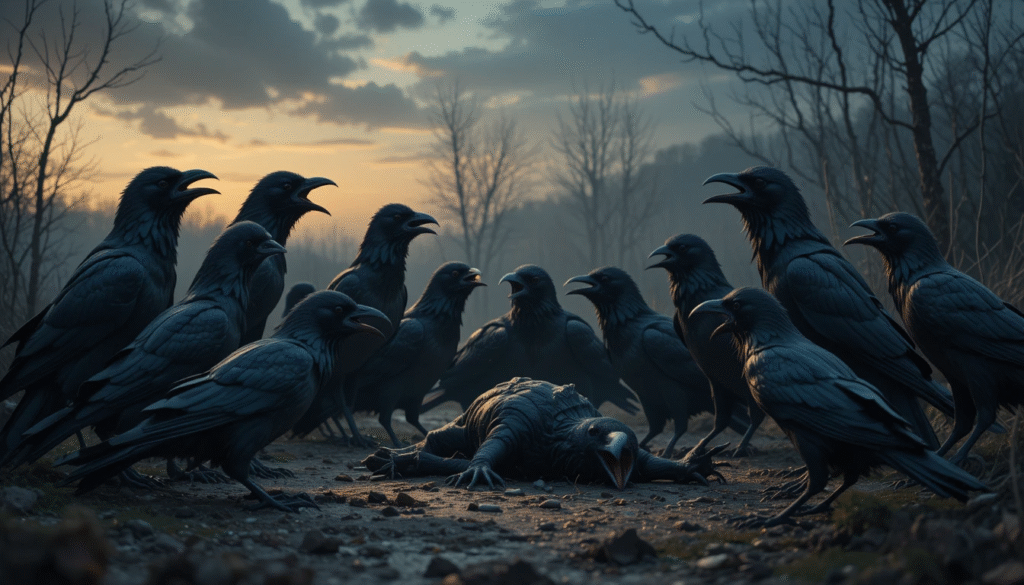
Crows, for example, are famous for stopping if one of their flock dies. Farmers in the old days, if you remember, would kill a crow, and when they killed it, they would hang its body, and the crows would gather around it, and cry out loudly, and after about 15 minutes, the group would disperse. The hypothesis says that they were avoiding that area, because it surely contained a predator or danger. But the truth is that even reactions to death differ from individual to individual, and from one group of crows to another.
Dr. Kaeli Swift, an ornithologist at the University of Washington, left crow corpses on the road. Most crows refused to deal with the dead animal, afraid that they might, for example, get infected with its disease, or eat something it ate that caused its death. They are cautious. About 30% of the cases involved them touching the corpse, out of curiosity: “We want to know what’s happening!” Or sometimes, they might be aggressive towards them. In about 4% of cases, they would perform sexual behaviors with the corpse, “necrophilia,” something that, despite its strangeness, characterizes intelligent creatures—not necrophilia specifically, but the idea of flexible, unexpected interaction.
Some people do this, and some people do that, and some people try this, and some people do completely different things. Not like programmed creatures, not like ants, for example, that might carry the corpse or eat the corpse.
Life moves in life with grace, not with programming. And like humans, there are intelligent individuals among them, and foolish individuals, and they are different. I mean, for example, one of the questions that science has not been able to settle is why crows gather on certain trees in autumn or winter. This question is like asking why people go to Central Park or Al-Azhar Park. You can direct it to sociologists or psychologists or historians, each one might give you a convincing, but not complete, answer.
Each answer will tell more about its author than, in the case of the crow, it will tell about the crow. Because science with all its tools and methodology has not been able to reach further than what legends have conveyed about crows, whether in their wisdom or in their being harbingers of destruction.
The Human-Crow Conflict: From Pest to Potential Ally
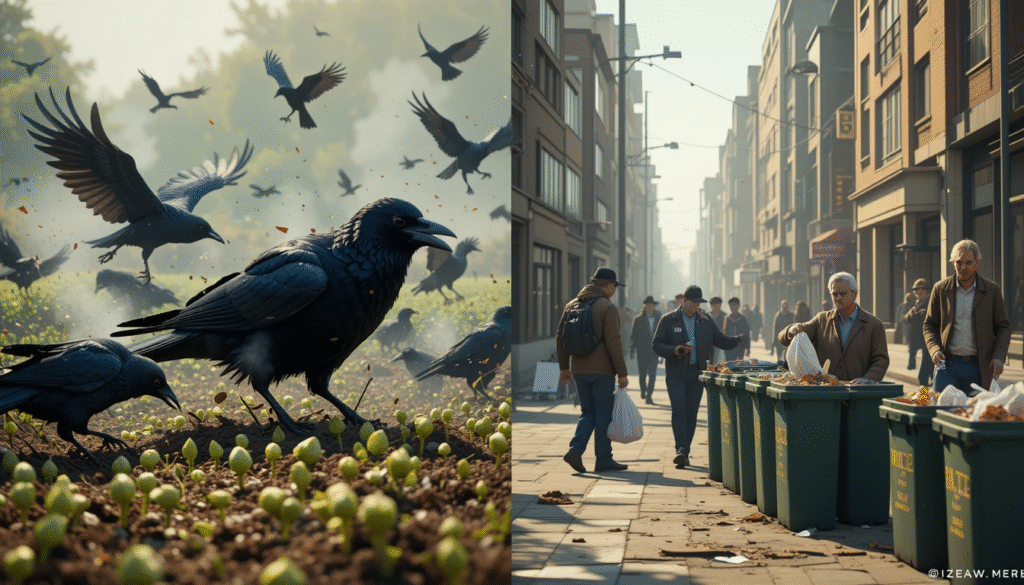
But is it really destructive? The crow, dear reader, is one of the worst pests, especially in villages. Why? Because it loves seeds and sprouts, so you find it attacking small birds and newborn calves and goats, so it is a destructive creature! The crow also carries in its droppings a fungus called Histoplasma, and also, a virus like the West Nile virus, and let me tell you that all methods of controlling them fail.
In the Canal governorates, for example, crows are a big problem, to the extent that the governorates sometimes launch campaigns to kill the crow. Dr. Mohamed Khalil, Undersecretary of the Ministry of Agriculture in South Sinai, says that the directorate launched campaigns against crows but they quickly had to stop them. Why? For fear of an ecological imbalance, as we talked about before. When you remove the crow, who will fill its place? Remember, crows finish off rats, they finish off insects, they are important prey for raptors like owls.
Even some studies say that killing them does not reduce their problems; on the contrary. Besides, killing them is very costly. France spends 45 million euros annually to kill crows, and it doesn’t even work! Every time they kill a group of crows, those who survive become more cautious and more intelligent; they learn, and it becomes harder for you to hunt them. And even if you finish off all the crows in a certain area, the crows in the neighboring areas will take their place.
That’s why some cities said: “Why are we hostile to them? Let’s try to cooperate.” So you find people, for example, training crows to collect garbage, pick up discarded cigarettes, and put them in trash cans, and in return, they get a treat. And indeed, the crows learned, and they passed on this experience, as we learned, to their friends. There are now campaigns that are turning the conflict between crows and humans into cooperation based on understanding crows and respecting their intelligence, control, and cooperation.
Conclusion: A Bird That Teaches Humility
Since humans first encountered crows, they have felt that they are creatures that challenge our sovereignty on the planet, test our limits, and interfere in our lives, explore our reactions, and find ways to deceive us, as if they are making us aware of their intelligence and the difficulty of confining them to rules, that not everything is easy to understand. There are still creatures in nature whose mystery and complexity remind us of how limited we are. So you have a creature that you can’t always hate like you hate monsters, nor can you always love it, because it’s not always nice and predictable.
But as the writer Hannah Kent said: “Crows are harsh creatures, but wise; creatures to be loved for their wisdom, if not for their kindness.” And the greatest wisdom that crows offer us is that they remind us to be humble before a nature of which we are a part. We are not the owners of this nature, nor its masters, to the extent that a simple bird in it is able to arouse within us fear, wonder, legends, and this respect, and forces us to learn from its deception and intelligence many times more than we have learned from its simplicity. That’s all, dear reader.