

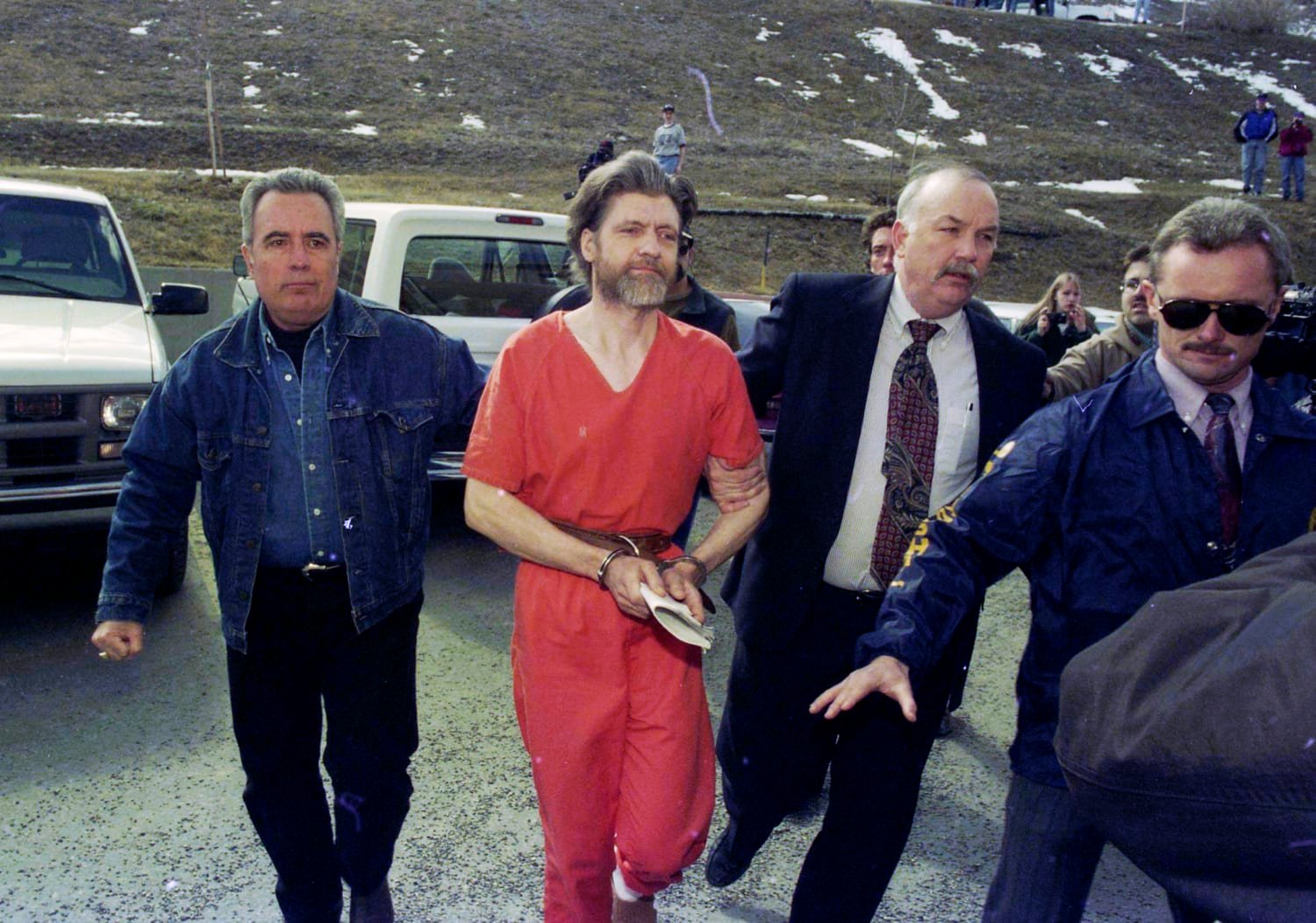
My dear viewer, let me take you by the hand to May 25, 1978. A very calm and pleasant day at Northwestern University. It was on this day that the events leading to The Unabomber Manifesto began to unfold. One of the university’s security officers finds a mail package in the parking garage. He doesn’t know who it’s from or who it’s for. Just as he was about to inspect it, boom, it exploded in his face. “Good heavens, Abu Hameed! Is this really a beginning?! Choose your beginnings, man!” Don’t worry, my friend, the bomb was primitive. The man only suffered a few scratches
The question here is, who was this package for? Who was it meant to harm? The package was originally sent to a professor at an art institute, the Rensselaer Polytechnic Institute. Because the package was too large for the mailbox, it had to be left on the floor. “Abu Hameed, I don’t understand any of this.” The truth is, my friend, this incident is less strange than the one I’m about to tell you now. On May 9, 1979, a humble technician working at the same university had a package in front of him. He went to look at it, and it exploded in his face, also causing minor injuries.
A Trail of Bombs: The Hunt for the Unabomber Begins
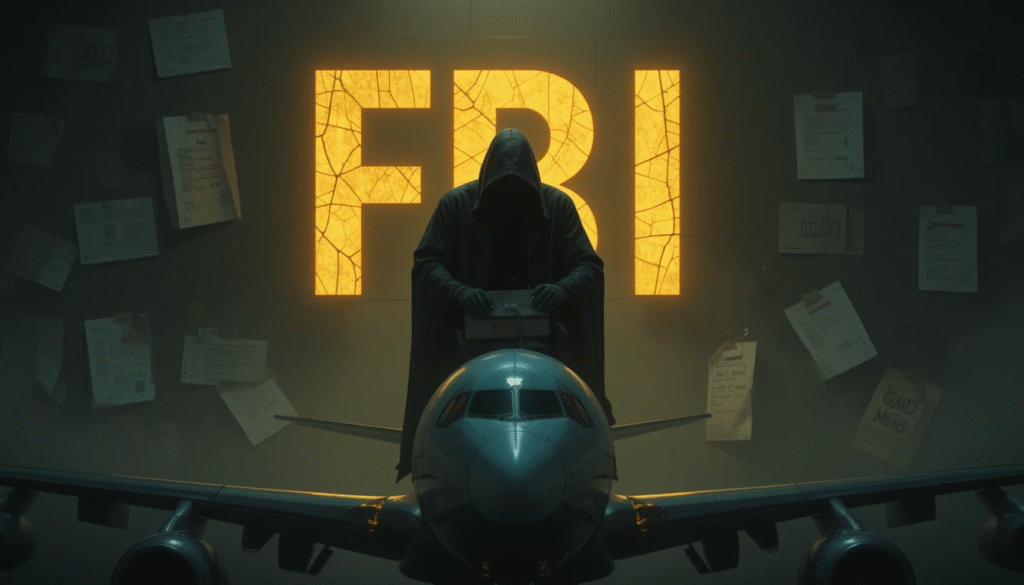
And that’s not all. We have a third incident. On November 15, 1979, a booby-trapped package, but this time it explodes where? On a Boeing 727 aircraft. And again, the incident passed without fatalities. Aside from Boeing’s terrible reputation, and how it has become the second most dangerous mode of transportation after race motorcycles, when you stop to think that a bomb could get past airport security and onto a plane, we have a problem.
This is what alerted the FBI. Two packages at a university could be a student with a problem with his professors, like someone who slashes a doctor’s tires, but they took it to the next level. But a package getting past the airport and exploding on a plane? That’s a big deal! The FBI began its investigation and started connecting the three bombings. And here, they arrive at a terrifying truth: “We are dealing with a terrorist targeting universities and airplanes in the United States of America.”
A terrorist who would begin a very dangerous chase with the FBI, and whoever found him would receive a million dollars. Imagine how many people would search for him in this world and the next! We are facing a new kind of terrorist, a terrorist delivery man sending booby-trapped “orders”! Over 18 years, teams of FBI officers, reaching 150 agents, were formed. They investigated more than 10,000 suspects, with costs reaching 50 million dollars.
On the other hand, the man kept working, relentless. He didn’t care about investigations or money. The man was going to bomb, and bomb he would. In 1980, a bomb exploded inside a mail package, injuring Percy Wood, the president of United Airlines. Again, it didn’t cause a death but resulted in very severe injuries.
At that moment, the FBI would name this terrorist the Unabomber—the university and airline bomber. It feels like he’s a specialized terrorist, but with a narrow, strange specialty: airlines and universities. He doesn’t go and bomb a supermarket, a student library, or a clinic. No, universities and planes. “This is my job, my field. Specific.” “UN” here is short for University, and “A” is for Airline. From that moment on, the explosions followed one another. America turned into a pot of popcorn, popping from a different spot every so often!
The Manifesto: A Terrorist’s High-Stakes Offer
This continued, my friend, until 1982, when the bombings suddenly stopped. “Wow, Abu Hameed! Did the terrorist repent?! That’s a nice happy ending. So, what are you going to talk about now?” My friend, the terrorist was likely pursuing higher studies at that time. He felt that his explosions weren’t that effective and weren’t clearly harming and killing people, so he decided to take a three-year hiatus until May 15, 1985.
The Unabomber returned with much more powerful bombs. Bombs targeting people like John Hauser, a computer professor at the University of California. Another bomb targeted the Boeing company in Washington. The incidents increased, but the targets remained the same. The man was loyal to his specialty: university professors, technicians, and airplanes.
The Unabomber ended 1985 with an incident involving a person named Hugh Scrutton, a student at the University of California who found a bag behind the store where he worked. But this time, the explosion was powerful enough to kill him. And here, my friend, for the first time, the Unabomber killed someone.
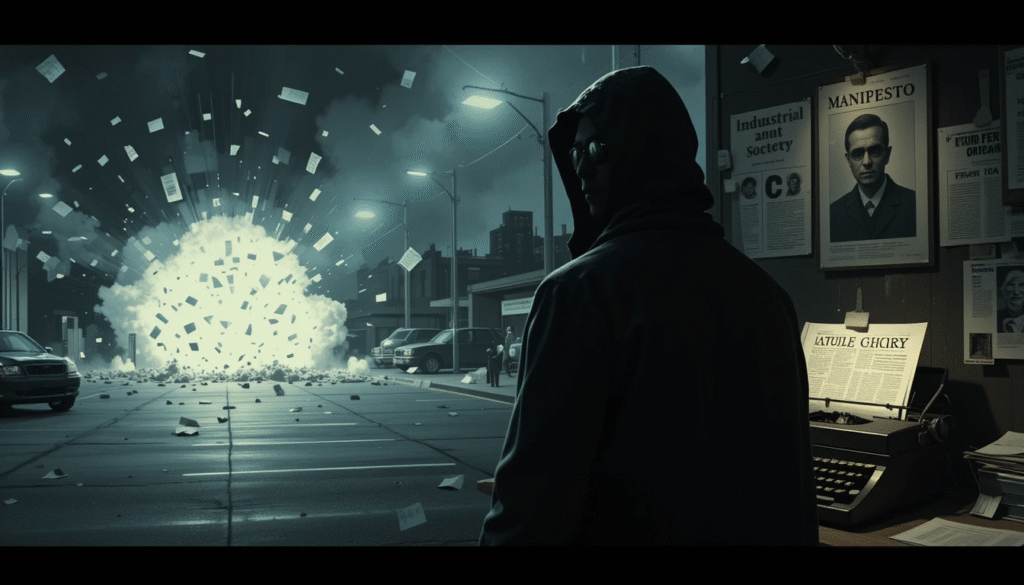
After two years of calm, suddenly, on February 20, 1987, an employee in Salt Lake City found a wooden box in a parking lot. The employee, my friend, thought the same, and took the box to her manager, when suddenly the bomb exploded, causing severe injuries! What was different about this incident this time was that the employee saw the Unabomber himself. Yes! She saw him in a cinematic shot, standing and watching the scene from a distance. He was in the parking lot watching his show, wearing a hoodie and dark glasses.
The police began to draw a composite sketch from the woman’s description, a sketch that would circulate throughout America, although it wasn’t clear, as you can see, nothing of his face was visible. The image spread across America, followed by a complete calm. For how long? Six years? The attacks resumed in June ’93. It was the first time I’d seen a terrorist take a gap year! He starts studying, attending conferences, and improving himself! And this time the return was with a booby-trapped package sent to one of America’s leading geneticists, Dr. Charles Epstein. After the explosion, the doctor lost his eardrum and fingers. The Unabomber didn’t stop there; he continued his strange crime spree intermittently.
And so it continued, with the perpetrator unknown, until The New York Times received a letter. In this letter, a claim of responsibility for these bombings was made by a group called the Freedom Club (FC), which declared itself an anti-technology anarchist group and claimed responsibility for these acts. In April ’95, The New York Times received another letter with an offer from the FC. They said they were willing to stop the exploding packages if the newspaper published their 35,000-word manifesto titled “Industrial Society and Its Future.” To add pressure, a letter was sent to Los Angeles International Airport threatening to blow up a random plane on a random day. .
This put the airport on constant alert. People at the airport remained on high alert for the bomb until another letter arrived, telling them: “We were just kidding.” A very exhausting psychological war was being waged.
The newspapers that received the manifesto threw the ball into the FBI’s court: “Should we publish this or not?” Here, the security team was divided. Should we publish a manifesto for a bomber who is twisting our arm? Or should we refuse and endanger our lives and the lives of others? They found an advantage in the manifesto’s size: “A document this large, if published, might lead us to the culprit. Surely, someone will recognize his writing style, someone has heard these ideas, they might report it.” On September 19, 1995, The Washington Post printed the American Unabomber’s letter, publishing it in a six-page large-format supplement.
A Brother’s Suspicion: The Clue That Led to a Capture
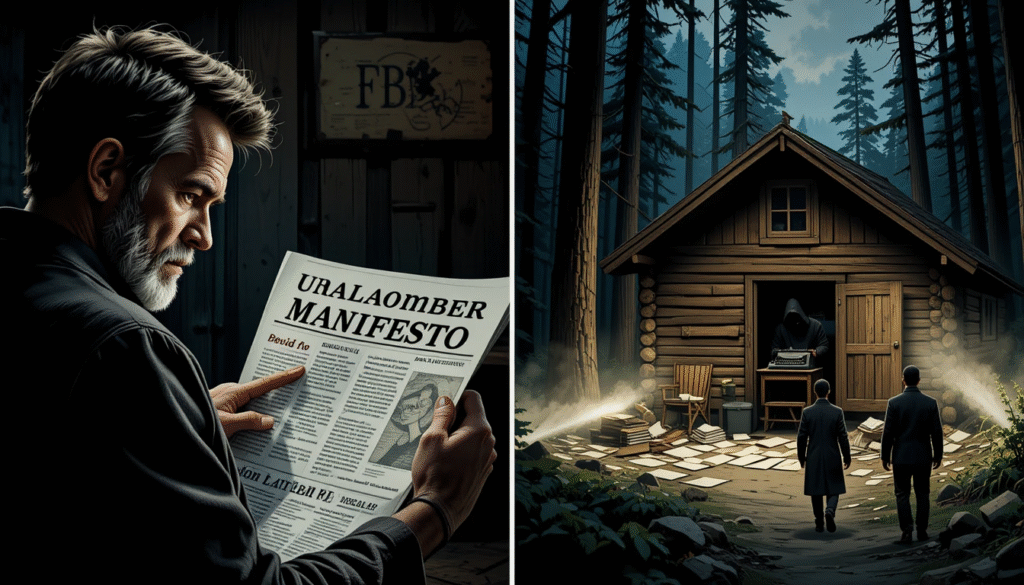
The manifesto was published, and controversy was stirred throughout America. The American public was surprised: “We have someone committing serial terrorist acts, and he has a philosophy!” His signature was a six-page large-format supplement! What kind of thinker has all these philosophical theories? The truth is, my friend, the manifesto was asking a very important question: Is technology for us as humans, or against us?
The manifesto was written with great care, but the writer exposed himself. One of the readers was a woman named Linda Patrik. She read the manifesto and then called her husband, David Kaczynski. She told him, “I suspect the person who wrote this is your brother, Ted. His writing style is similar to the letters he sends you.” Here, David Kaczynski looked at her in terror and said, “Oh my God! You’re reading the letters?! Woman, I keep them locked in a drawer, that’s not right!” She replied, “Man, what are you talking about? Your brother is a terrorist! The person who wrote this is likely the boys’ uncle.” Of course, I’m kidding.
The truth is, David took the manifesto and started reading. He was shocked. The style was indeed very similar to his brother’s. David Kaczynski was caught between two fires: either turn his brother over to justice or let his conscience burn him forever.
To avoid a burnt conscience, David made up his mind and informed the FBI. David’s report was like a lifeline for the investigation. At that time, the list of suspects had reached 2,417 people. Ted was the second to last, number 2,416. David also handed the FBI an old manuscript of the published manifesto, the first draft, which he had found in the family home.
Suddenly, Ted’s stock rose, and all eyes were on him. Ted Kaczynski became the number one suspect. On April 3, 1996, the FBI moved in. 78 federal agents surrounded Ted in an isolated cabin in the forests of Montana, a cabin with no water or electricity. And here, my friend, a 17-year journey of booby-trapped packages came to an end. During this period, there were 17 bombings, in which 3 lives were lost and 23 people were injured.
Who Was Ted Kaczynski? From Child Prodigy to Terrorist

Now, of course, there’s a very important question: Who is Ted Kaczynski? On May 22, 1942, Ted Kaczynski was born, and he was not an ordinary child. He was a genius with an IQ of 167. This is a very high number. Stephen Hawking’s IQ was said to be 160, so we are talking about an exceptional child. In 1958, Ted received a scholarship to Harvard at the age of just 16. Some described him as the new Einstein. Ted finished college and earned a Ph.D.
in pure mathematics, a field he described as just a game for him. In 1968, Ted was appointed as an assistant professor at the University of California, only to resign four years later. With all the money he made from the university, he went and bought a cabin in Montana.
When asked why someone would leave academia, Ted said he took the university job just to make money. “I took academia as a path, a bridge to become a farmer.
All I wanted was to make some money, buy a piece of land, leave society and this system, and live in the wild.” He said, “Since 1962, I have been against technology.” From 1972 to 1978, Ted analyzed and wrote, finally arriving at an idea: “I will not just live alone; no, I will take a stand against the industrial society we live in.” And he began his work from his small cabin, launching the largest manhunt against the elite of industrial society: scientists, company presidents, technicians. The rest, you know well from the episode.
If you think about Ted, you’ll find he was a special kind of terrorist. In his book “Terrorism: A Very Short Introduction,” Charles Townshend considered one of the biggest problems with terrorism to be its many definitions. The strange thing is that Ted Kaczynski doesn’t fit any of the typical descriptions of a terrorist.
We are looking at a brilliant academic, someone with no extreme religious or political leanings. Yet, paradoxically, Ted represents terrorism in its purest form. He breaks the stereotype of a terrorist completely. Ted has the common core of all terrorists: the use of violence to send shocks through society, to change society by attacking it, to force the victims of his violence over 18 years to listen to his words, his ideas. He wanted a voice. And Kaczynski’s voice, in this case, was the manifesto that was published, “Industrial Society and Its Future.”
Inside the Unabomber Manifesto: The “Power Process” and “Surrogate Activities”

The manifesto, my friend, begins with a highly dramatic sentence: “The Industrial Revolution and its consequences have been a disaster for the human race.” Ted considered industrial progress to be the main reason for the difficulty of our lives. Instead of making it easier, it made it more complex, turning everything around us into a source of physical and psychological suffering. To understand Ted’s mind better, we need to ask a question: What makes you feel self-worth? What makes you feel free? Ted, my friend, answered this question with two words: “the power process.” This is a four-step process: set a goal, make an effort, achieve the goal, and finally, as a result, feel autonomy.
Ted saw humans as beings who target certain things and achieve them, simply put, in control of their destiny. Ted argued that all humans have basic goals like food and shelter, but the power process he meant involved much more complex goals. Let’s imagine a life goal for you: writing a book, becoming a famous actor, or starting a successful business. These are goals to which Kaczynski’s power process applies: Goal + Effort = Goal Achievement + Autonomy.
The problem, according to Kaczynski, is that in industrial society, most people don’t have the freedom to set such goals and pursue them. The society tells you: “Wait, we don’t have that here. Everyone having their own independent goal and achieving it independently?
How would the factory run? We are all children of the company, we work for the company, not to grow on our own.” Industrial society, according to Kaczynski, is characterized by overspecialization. A society that needs specialists for specific goals that it has set. Your goals are imposed on you by the factory. To the point where this society makes you feel that if you don’t dedicate your entire life, talents, and abilities to this goal, then you are mentally ill and a failure. Why? Because you are not useful.
Ted Kaczynski called this deviation “surrogate activities.” “Surrogate,” my friend, is often found in the term “surrogate mothers.” Ted saw this as an empty pursuit. It might give you money, a job, and status, but the child inside you is not yours. This job will give you everything in life and take from you the best thing in it: meaning.
Technology’s Trojan Horse: Freedom Lost, Not Gained
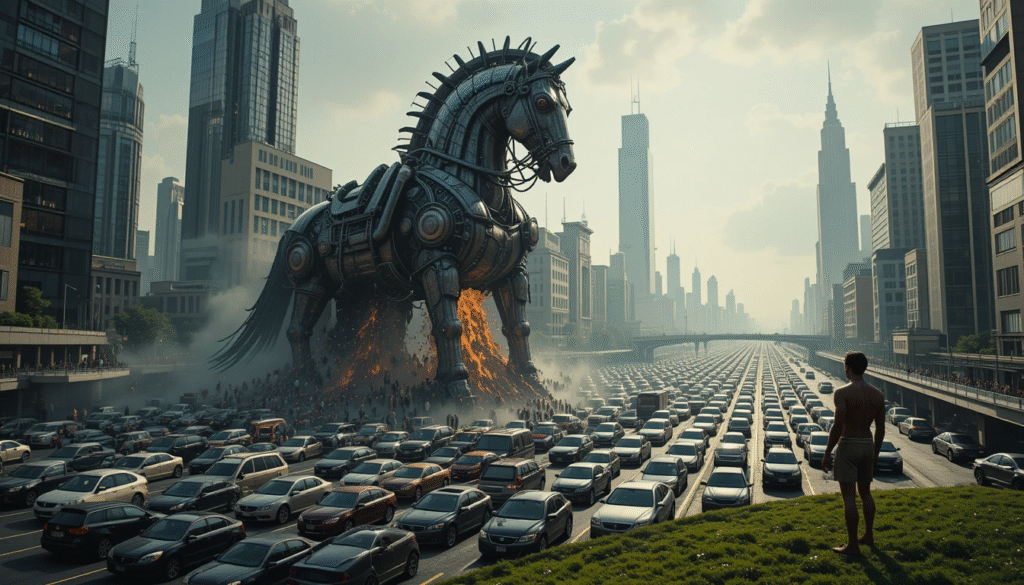
According to Ted, primitive man, despite all the dangers surrounding him, was not terrified that his future would be destroyed because the stock market crashed in America or because the real estate market was down. Today, you are not involved in many conflicts that could be responsible for your destruction. Weapons not intended to kill you could be responsible for your death. According to Ted, primitive man had the ability to change.
If I am in a dangerous area, I can go to another place, another cave. If the land is dry, I look for another river. But you, as a modern human, cannot change the economy, you cannot change the way of governance. Two leaders living on distant continents can have a dispute, and the effect of their quarrel can be felt in your room!
Let me give you an example here. In 1962, animal behaviorist John B. Calhoun conducted a series of experiments on rats. Rats were confined in a closed environment, completely fortified from dangers, a small society full of unlimited resources: food, water, as you wish.
No worries about hunger, housing, or sex. But as the number of rats increased, behaviors like violence, isolation, and mothers neglecting or even killing their children began to appear. Birth rates dropped, and the small society began to collapse. This study was done to understand the effects of overpopulation on human behavior. All this in a well-controlled environment, a carefully designed environment with all the resources they needed, but what this environment lacked was that its individuals did not exercise freedom of choice.
Imagine if we went back 1,000 years and gave primitive man a gift: “Take this car.” You start teaching people how to make their own cars and tell them that everyone is free with their car. Over time, cars increase, people are forced to build roads for them. After a while, traffic lights are needed. Suddenly, an invention that was meant to free man from the limitations of his body, to move him faster than his available speed, suddenly this invention made the whole society adapt and depend on it, changing its form and features bit by bit to fit its size. Today, we build cities not for humans, we build cities for cars.
Chilling Predictions and a Violent Legacy
“But Abu Hameed,” you might say, “why destroy the world to say what we want to say?” The truth, my friend, is that Ted saw this capitalist society, where the employee or worker feels alienation, meaninglessness, and a lack of a real role in what they do, as a sick society. This sickness would kill it after many long years, torturing it during the period it lives. So his opinion was, like in Fight Club, to destroy the system quickly.
Perhaps, in the end, when we finish talking about Ted’s manifesto, you’ll find it a bit pessimistic. But the truth is, we are seeing his predictions in the world today. Ted predicted, for example, that if society continued on its current path, AI tools would emerge to take our place.
As long as this system doesn’t change, smarter tools will come to do our work. Then, we will be faced with two solutions: either these tools evolve to the point where they no longer need us, or we voluntarily give them the advantage of making decisions for us because they are supposed to think faster and more efficiently. Over time, society will become domesticated to this situation. Then, any return to the original form, where a person’s decision comes from their own mind, will be tantamount to suicide for society. Freedom will collapse completely. You’ll just be paying subscriptions!
This scenario, if extended, could lead to a catastrophe where a certain elite controls societies by owning the most advanced AI. From here, we can understand the brutality of Ted and the crimes he committed. He was obsessed with a much more horrific future and was convinced in his thinking that the current society is impossible to reform. Or as he put it, “You can’t eat your cake and have it too. To get something, you must sacrifice something else.”
Ted Kaczynski, my friend, went through a very strange journey. From a person with a philosophy but no voice, he chose the most violent means to convey a philosophy that was supposedly noble in purpose. Even after his arrest, he confessed to all his crimes, denying none. From a life sentence until he was diagnosed with cancer in the prison hospital, Ted Kaczynski lived his final days. Until we reach June 10, 2023. Ted committed suicide. He committed suicide, my friend, with his shoelace, inside his cell, after suffering from cancer and refusing any treatment for it.
Ted’s suicide ended the extraordinary life of a very intelligent person, a person who criticized the system that runs our entire lives. It’s difficult to claim that Ted Kaczynski was a charlatan or a publicity seeker. He did not seek attention, because he applied his ideas to himself before anyone else, living for about 30 years in an isolated place to practice these ideas. It is very difficult to sympathize with his criminal methods, which killed many innocent people, but what is certain is that Ted’s manifesto is unlikely to die with him.
What is certain is that it will remain and will be invoked in many things. And perhaps we can say, in one way or another, that he has some valid predictions about what might happen, such as the use of artificial intelligence in genocide, the use of advanced technology to destroy cities, the levels of mental health in modern cities, not to mention the impact of technology on the environment. This makes every new generation that reads Ted’s manifesto feel that there is something right in what the man is saying.
They might feel repulsed by his story and his crimes, they might feel terrified by the accuracy of his predictions—predictions that, if they come true to the end, will lead us to a future much worse than our present. And that’s all, my friend.